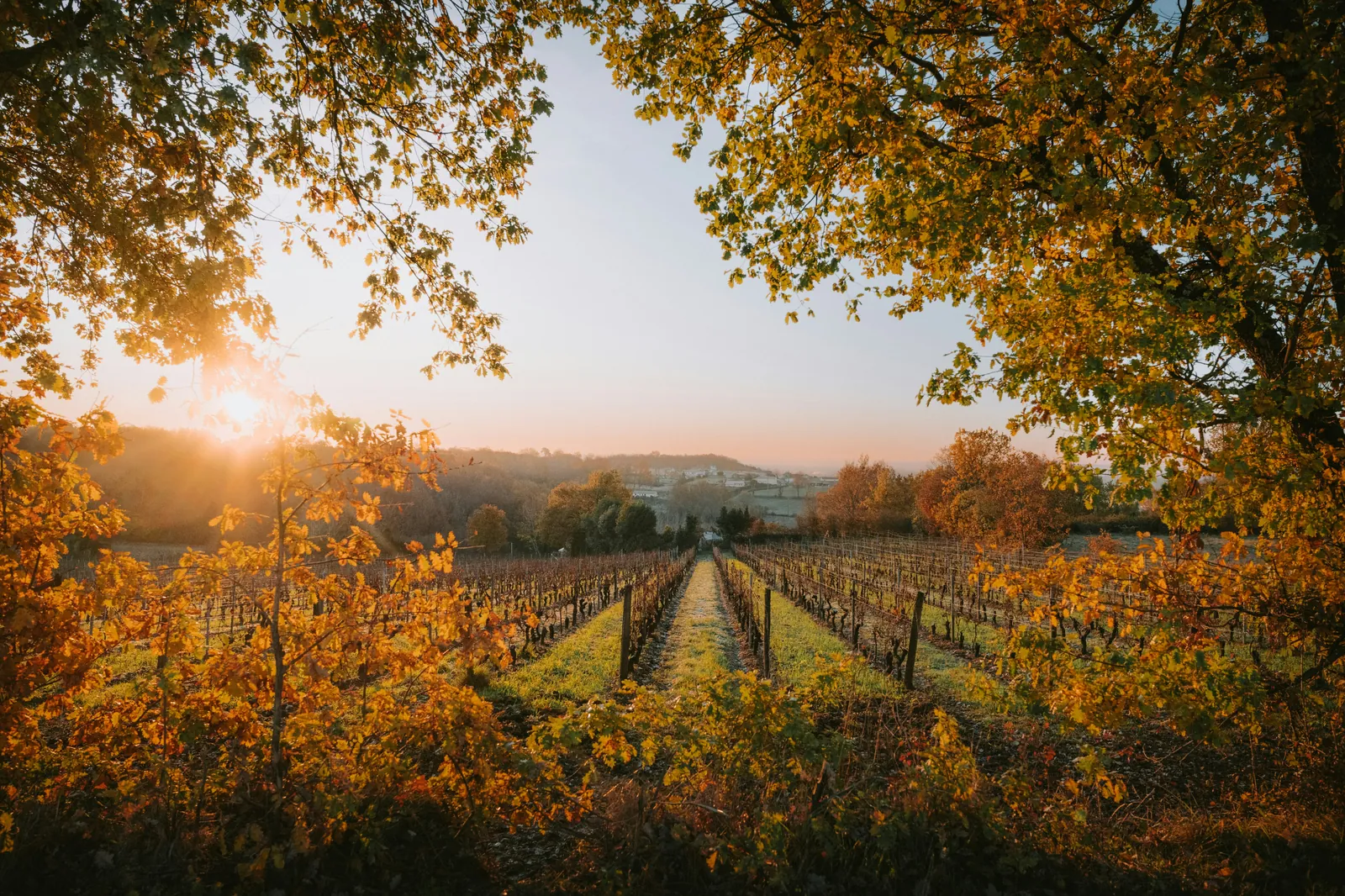
What a red Bordeaux actually tastes like
A young red Bordeaux announces itself: blackcurrant, blackberry, sometimes graphite or cedar when Cabernet Sauvignon leads. Cross the river to the right bank, where Merlot dominates, and it shifts towards cherry and plum, with a roundness that arrives earlier on the palate.
Almost every Bordeaux is a blend, which is why no grape appears on the front label. That is the first thing to unlearn if you are used to buying by variety. Cabernet Sauvignon brings structure, tannin and the capacity to age; Merlot brings flesh and approachability; Cabernet Franc, often a smaller share, adds a leafy, peppery lift. The proportions shift by estate and by year.
Tannin is the other signature. Young Bordeaux can feel firm to the point of austerity, which is not a fault but a design: these are wines built to soften. If a bottle tastes tight and dry on opening, decanting it for an hour usually tells you more than the first sip did.
Left bank, right bank: the river does the work
The Gironde estuary splits the region in two, and that split explains most of what you taste. On the left sits the Médoc, with deep gravel soils that drain fast and hold heat, which suits late-ripening Cabernet Sauvignon. The village names there read like a roll of honour: Pauillac, Saint-Julien, Margaux, Saint-Estèphe. Expect structure, cassis and wines that reward patience.
On the right, around Saint-Émilion and Pomerol, the soils carry more clay and limestone. Merlot ripens better there, and the wines are rounder, softer and drinkable younger. Pomerol in particular has no classification at all, which has not stopped it producing some of the most expensive wine in France.
Between the two lies Entre-Deux-Mers, literally « between two seas », which in practice means between two rivers. It is best known for dry whites and is where a great deal of the region's everyday value sits.
One word to clear up: château on a Bordeaux label means an estate, not a castle. Many have no grand building at all. It is a legal term for a producer working defined vineyard land, and it says nothing about the size or the architecture of the place.
The 1855 classification, in five minutes
In 1855 Napoleon III asked for a ranking of Bordeaux's best wines for the Paris Exposition. Local brokers produced one in five tiers, from First to Fifth Growth, and they based it largely on the prices the wines were fetching at the time.
That is the crucial detail: it was a snapshot of the market in a single year, and it has barely moved since. One estate was promoted in 1973. Otherwise the list of 1855 is the list you still read today, which means it reflects nineteenth-century commercial standing rather than current winemaking.
Use it as history, not as a shopping guide. Plenty of unclassified estates now outperform classified neighbours, and the classification covers only the Médoc and Sauternes; Saint-Émilion runs its own, revised periodically, and Pomerol has none. A wine can be excellent and appear on no list at all.
Vintages, and why they matter more here
Bordeaux sits far enough north that the weather genuinely changes the wine from year to year. A wet spring, a cold summer or a heatwave move the result more than they would in a warmer region, which is why vintage charts exist for Bordeaux and barely for others.
What to take from that: in a difficult year, the gap between a careful producer and a careless one widens, so the name matters more. In a strong year the whole region rises, and modest appellations become unusually good value because attention stays fixed on the famous names.
You do not need to memorise anything. Before buying several bottles of one year, look it up; the information is free and takes a minute. And bear in mind that older is not automatically better. A middling vintage at fifteen years old can be past its best while a strong one is only starting to open.

Estates worth knowing, beyond the famous names
Everyone has heard of Pétrus, Mouton-Rothschild and Cheval Blanc, and their prices have long since left the realm of dinner. The more useful territory is the estates that hold real quality without the auction-house premium.
Look at the so-called satellite appellations first: Lalande-de-Pomerol next to Pomerol, or Montagne-Saint-Émilion beside Saint-Émilion. Same broad terrain, same grapes, a fraction of the price, because the famous name on the sign next door is not theirs to use.
In the Médoc, the cru bourgeois category is worth a look. It sits below the 1855 tiers, is reassessed regularly rather than frozen, and covers a good number of estates that make serious wine at a sane price. It is the closest thing Bordeaux has to a working quality signal, precisely because it can be lost.
Common questions
What is the difference between a Bordeaux and a Grand Cru Classé?
Bordeaux is the regional appellation, the broadest one, covering the whole area. Grand Cru Classé means the estate appears in a classification, most often the 1855 list for the Médoc or the Saint-Émilion ranking. It signals historic standing rather than current quality, and many unclassified estates now make better wine than classified ones.
Do you really have to wait ten years before opening a good Bordeaux?
Not always. Right bank wines with a high proportion of Merlot are often enjoyable within five years. Structured left bank wines from a strong vintage genuinely improve over a decade or more. If you are opening one young, decant it: an hour in a carafe does much of what a few years in a cellar would.
How do you match a red Bordeaux with a meal?
Its tannin wants protein and fat. Lamb, beef, duck and hard cheeses all work. Avoid delicate fish and anything with strong chilli heat, which fights the tannin. Serve at around 16-17 °C rather than at room temperature, which in a heated house is too warm.
Are white Bordeaux worth trying?
Yes, and they are consistently underrated. Dry whites from Sauvignon Blanc and Sémillon, especially from Pessac-Léognan, combine citrus freshness with real texture. Sauternes, the sweet wine of the region, is a different proposition altogether and one of the great dessert wines.
What should you expect to pay for a good Bordeaux?
Around 15 to 25 euros buys a genuinely good bottle from a cru bourgeois or a satellite appellation. Below 10 euros you are usually in generic regional blends, which can be pleasant but rarely memorable. The steep prices attach to a small number of classified estates and are driven by scarcity and reputation as much as by what is in the bottle.