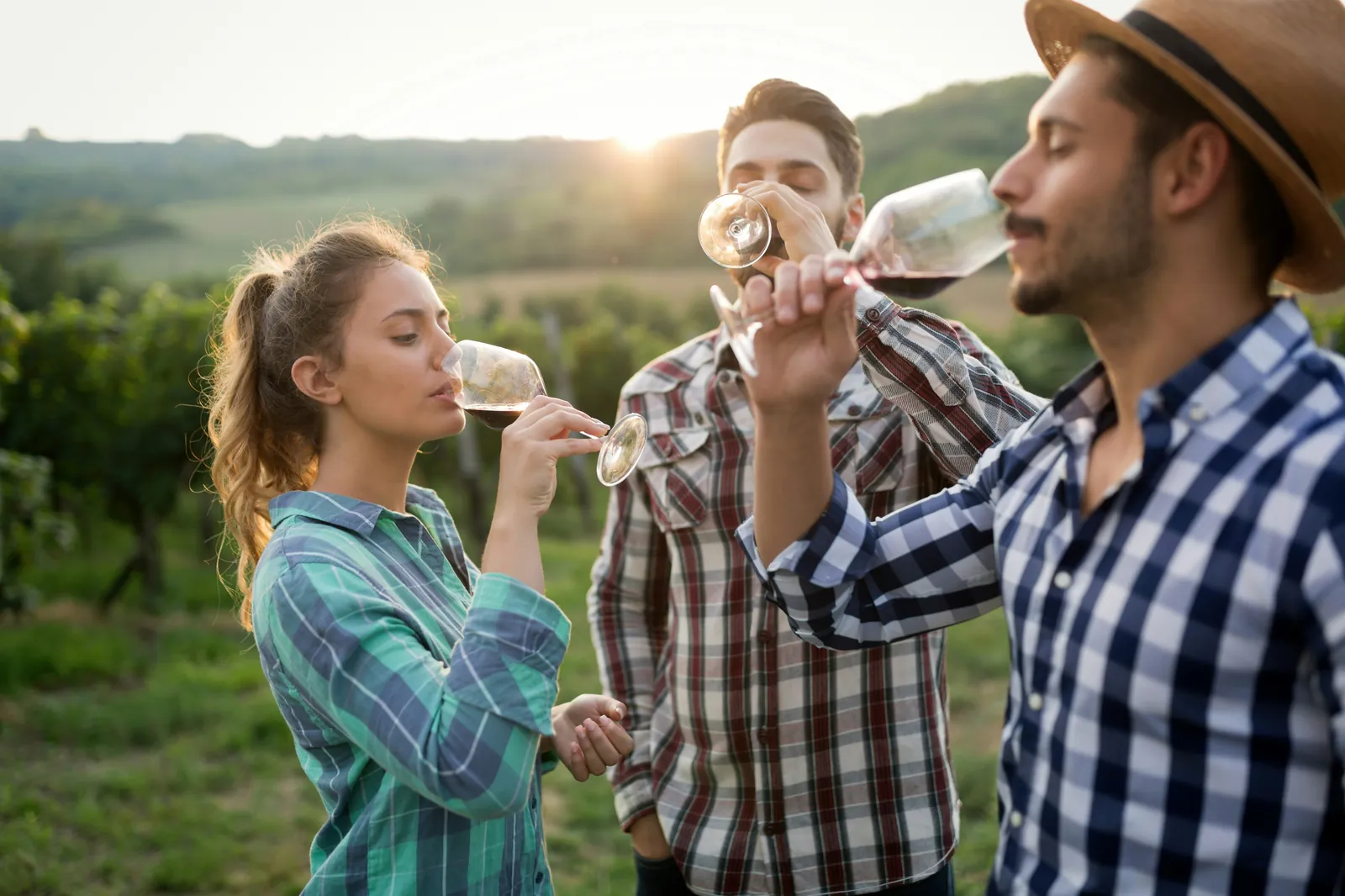
What grows here — and why it tastes like nothing else
Before we talk kilometres and parking, let's talk about what's in the glass. What makes Burgundy so disorienting — and so compelling — is that a single grape variety, Pinot Noir for the reds or Chardonnay for the whites, changes character radically from one plot to the next. Two domaines 200 metres apart can produce wines that have almost nothing in common. That's not wine-shop poetry: it's what you'll actually smell and taste if you do the route properly.
This sensitivity to place is what Burgundians call terroir — the combination of soil, subsoil, slope, aspect and microclimate that gives each small plot its distinct personality. Burgundy's vineyards are classified into a four-tier hierarchy: generic Bourgogne at the base, then village appellations (wines labelled with a commune name like Gevrey-Chambertin), then Premier Cru (specific named plots within a village), and at the top, Grand Cru — 33 individual plots across the whole region that have their own appellation and appear on the label without any village name at all. The difference in price between tiers can be dramatic; the difference in character is real.
On the Côte de Nuits — the northern half of the route — the Pinot Noirs run deep: black cherry, violet, sometimes a smoky woodland note when the wine has a few years on it. In Gevrey-Chambertin it's usually power that hits you first. In Chambolle-Musigny it's finesse, almost delicacy. These aren't subjective impressions: they follow directly from the geology, the aspect and the altitude of each plot.
On the Côte de Beaune — the southern half — white wines dominate. Meursault greets you with hazelnut butter, white peach, a texture that borders on creamy. Puligny-Montrachet pulls in the opposite direction: mineral, taut, the kind of wine that makes you reach for another sip immediately. Understanding these differences is understanding why this route exists. Our guide to Burgundy wines will give you the foundations before you set off.
The goal isn't to visit everything. It's to choose two or three villages, spend real time at each domaine, and let your palate do the comparative work. That's when it starts getting interesting.
Dijon to Santenay: the stops you shouldn't skip
The route begins at Marsannay-la-Côte, a few kilometres south of Dijon, and runs down to Santenay. It follows the RD974, a narrow departmental road that runs close alongside the vines. Travel it north to south: start with the Côte de Nuits, finish with the Côte de Beaune.
Côte de Nuits: Fixin, Gevrey-Chambertin, Morey-Saint-Denis, Chambolle-Musigny, Vougeot, Vosne-Romanée, Nuits-Saint-Georges. This is Pinot Noir country at its most concentrated. Allow a full day if you want to stop properly — Gevrey-Chambertin alone is worth two or three hours between the village itself, the medieval château, and a tasting at one of the domaines that accepts walk-in visitors.
Côte de Beaune: Aloxe-Corton, Beaune, Pommard, Volnay, Meursault, Puligny-Montrachet, Chassagne-Montrachet. Beaune is the logical hub — hotels, restaurants, and the Hôtel-Dieu, a 15th-century charitable hospital whose roof is tiled in the multicoloured glazed geometric patterns that have become one of Burgundy's most recognisable images. Plan a second full day for this stretch.
Nuits-Saint-Georges works well as a mid-point overnight stop. The town has good restaurants, a real local feel, and you're positioned exactly halfway along the route. Several well-regarded domaines here accept visitors without elaborate advance arrangements — welcome when you arrive tired at the end of the day.
If you want to compare the Burgundy experience with another major French wine region, our guide to visiting Bordeaux domaines shows just how different — and complementary — the two approaches are.

Choosing your domaines without drowning in names
Hundreds of producers across 60 kilometres. The first decision: independent family domaines, or négociants who offer a wide range across the whole Côte d'Or?
A domaine in Burgundy is a wine estate that grows its own grapes and makes its own wine. Family domaines are typically small — sometimes just a few hectares — and they give you direct contact with the person who made the wine. Tastings are intimate, sometimes improvised in the barrel cellar. This is where you feel the attachment to individual plots. The trade-off: they almost always require an appointment, especially in July and August and during harvest in September and October.
A négociant is a merchant-producer who buys grapes or finished wines from growers across the region and bottles them under their own label. The major Beaune négociants — Bouchard Père & Fils, Louis Jadot, Joseph Drouhin — have impressive historic cellars and structured visitor operations. You can taste a wide range in a single visit, with English-speaking staff and no booking anxiety. A solid starting point for a first trip.
Our selection of the best Burgundy producers will help you target domaines by budget and style. There's no point queuing outside an over-hyped address when a neighbour two doors down accepts walk-ins and produces wines just as worth your attention.
One practical rule: no more than three domaines per half-day. Beyond that, your palate tires and your memories blur. Write down what you taste, even just in a pocket notebook. You'll be glad you did in three days' time.
When to go and how to get organised
The timing question comes up constantly. September and early October are spectacular — the vines turn colour, the domaines are in full harvest activity, and some vignerons will spontaneously invite you to watch the picking. But many producers are so stretched during harvest that tastings get rushed and appointments get cancelled. If the quality of conversation matters to you, aim for May to June, or November once harvest is done. The vines are beautiful in spring and the vignerons actually have time for you.
For getting around, a car is the most practical option. Important caveat: if you're tasting seriously, designate a driver or use the shuttle services that run from Beaune and Dijon. Several operators offer chauffeured van tours — they solve the drink-driving problem neatly and let everyone taste without restraint.
Set a clear tasting budget before you arrive. Free visits exist, but tasting Grands Crus — wines from those 33 top-classified individual plots — is often charged, and reasonably so. Expect to pay between €20 and €80 depending on the domaine and the level of wines poured. Some tastings include a discount on purchases: if you're buying bottles to take home anyway, that can offset the cost of the session.

What to eat along the way
Burgundian cooking was built to go with Burgundian wine, not the other way around. This is one of the regions where food and wine pairing requires no intellectual effort. A Gevrey-Chambertin with a bœuf bourguignon — the classic slow-braised beef stew cooked in red wine — is self-evident from the first mouthful.
Village auberges along the route serve well-executed classics: œufs en meurette (eggs poached in a red wine reduction with lardons and mushrooms), escargots baked in garlic and parsley butter, thick-cut jambon persillé (a cold terrine of ham set in parsley-flecked wine jelly). These dishes were made for these wines. You'll understand that the moment you eat them together.
On the white wine side, a Meursault with a Bresse chicken in cream sauce looks simple on paper. It's been thought through with care: the richness of the Chardonnay holds its own against the fat of the cream, while the wine's acidity cuts through and refreshes the palate between bites. Bresse, the area just east of Burgundy, produces chickens under a protected designation — they're considered the finest table chicken in France. In Beaune, Ma Cuisine has long been the reference for this kind of unpretentious, precise pairing.
For cheese, the Saturday morning market in Beaune is worth getting up for. Époisses — a pungent washed-rind cheese whose rind is rubbed with marc de Bourgogne, the grape spirit distilled from pressed skins after fermentation — is the natural companion to an older Gevrey-Chambertin: powerful, generous, completely in keeping with the region's character. For a gentler pairing, a young Comté (a firm, nutty aged cheese from the Jura, just to the east) with a Meursault. Hazelnut answering hazelnut. It really is that simple.
Ordering wines from the route before or after your trip
Not everyone can drive home with a case of Vosne-Romanée in the boot. Between the weight, the fragility and the prices, physically transporting bottles from the domaines takes real planning. And even if you manage it, you won't be able to go back and buy every appellation you discovered along the way.
A well-curated online wine retailer makes sense in this context. Vinatis, a French online wine shop that ships across Europe, carries a broad Burgundy selection covering the appellations you'll have passed through, with detailed tasting notes and well-sourced vintages. Useful for ordering after the trip what you most enjoyed tasting, or for opening a few bottles at home before you leave to get your bearings.
One practical habit: note down producer names and cuvée names as you go. A wine sold directly at a domaine for €35 sometimes appears at an online retailer for a comparable price, without the logistics of getting it home. And you can order several bottles without wondering how they'll survive the journey back.
If you tasted any Chablis before or after the route — worth noting that Chablis is technically part of Burgundy's appellation system but sits about 100 kilometres northwest of the Côte d'Or, close to Auxerre — our Chablis guide explains how to navigate the hierarchy from Petit Chablis up through Chablis village to Premier and Grand Cru. The price gaps between levels are significant, and understanding why helps you spend your bottle budget more wisely.
Common questions
Do you always need to book in advance to visit domaines on the Grands Crus Route?
For small family domaines, yes — an appointment is almost always essential, particularly in high season and during harvest (September and October). The larger négociant houses in Beaune, which buy grapes from across the region and produce wines under their own labels, accept walk-in visitors, though the experience is more structured and less personal. For family domaines, contact them two to three weeks ahead by email or phone; many have English-speaking staff or reply in English.
How many days does the route really take to do properly?
Two days is the minimum if you want to stop with any seriousness. Three days is better — it lets you alternate between the Côte de Nuits and the Côte de Beaune without feeling rushed. A week gives you space to explore the secondary villages, visit the historic cellars in Beaune, and take detours up into the Hautes-Côtes, the hillside vineyards above the main route that produce lighter, more affordable wines.
Can you do the route by bike?
Yes, and it's one of the best ways to experience it. The EuroVelo 6 long-distance cycling route passes close by. Electric bike hire is available in Beaune and Nuits-Saint-Georges. The obvious advantage: no drink-driving concern after tastings, and you see the vineyards at a pace that actually lets you read the plot markers and notice the changes in soil from one appellation to the next.
What should I budget for tastings on the route?
Between €50 and €150 per person per day for tastings alone, depending on the domaines you choose. Entry-level village tastings cost €10 to €20. Tasting Premier Crus and Grands Crus — the top two tiers of Burgundy's classification — at serious domaines quickly reaches €40 to €80 per session. Budget separately for buying bottles; it's easy to spend as much again on purchases, and many domaines offer a discount on what you buy after a paid tasting.
Do wines from the Grands Crus Route age well?
Many of them, yes. Top red Grands Crus from Gevrey-Chambertin or Vosne-Romanée will hold and develop easily for 15 to 25 years in good storage conditions — a cool, dark place with stable temperature and no vibration. Premier Crus generally drink well over 8 to 15 years. Village-level Bourgognes are typically best within 5 to 8 years. Practical rule: if you don't want to wait, buy bottles from already-mature vintages rather than the most recent releases. Domaines and good retailers will advise on which years are drinking well now.