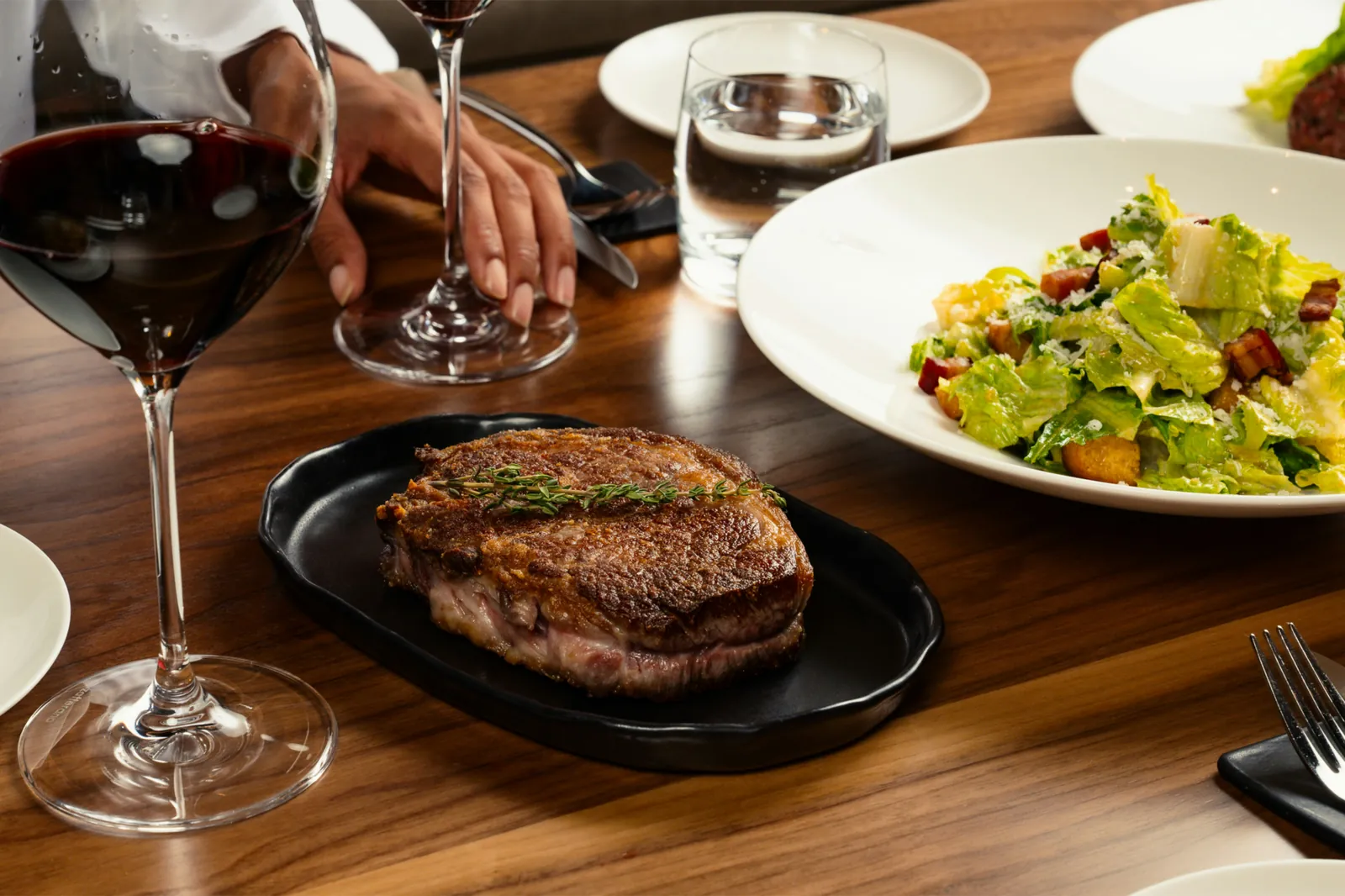
Red calls for red — but not just any red
The instinct is sound: when you serve red meat, you reach for a red wine. But instinct alone doesn't take you far enough. A rare beef fillet and a slow-braised beef stew don't call for the same glass at all, even though the raw ingredient is identical. The first thing to train yourself to think about is the preparation, not just the meat itself.
What holds a wine-and-meat pairing together is the relationship between the wine's tannin structure and the texture and fat content of the meat. Tannins — the molecules responsible for that slightly drying, gripping sensation you feel on your gums after a sip of a young red — bind well with the proteins and lipids in animal flesh. When there's a mismatch, you feel it immediately: a heavily tannic wine on a lean, delicate cut tastes harsh, almost aggressive. A wine that's too light alongside a well-seasoned leg of lamb simply disappears into the sauce.
Acidity matters just as much. A wine with good natural acidity — a red Burgundy made from Pinot Noir, or an Italian Chianti from Sangiovese — cuts through the fat in the meat and makes you want another bite. That's the dynamic you're looking for: wine and food relaunching each other, back and forth across the plate. That's the basic mechanics. Now for the detail.
Grilled and pan-seared beef: wines that can hold their ground
A grilled entrecôte, a rib of beef over charcoal, a rare steak with nothing but salt and pepper — this is the territory of structured, serious reds. You have chew, intramuscular fat and the deep, seared aromas that come from high heat. You need a wine that can stand up to all of that without blinking.
From France, the Médoc is the obvious starting point. The Médoc is the long peninsula west of Bordeaux city, running along the Gironde estuary, and it produces some of France's most celebrated reds from Cabernet Sauvignon, often blended with Merlot and Cabernet Franc. A Saint-Julien or a Pauillac — two of the Médoc's most prestigious villages, each with their own AOC (Appellation d'Origine Contrôlée, France's system of geographically controlled wine designations) — with a few years of bottle age behind it gives you Cabernet tannins that have softened and integrated, along with notes of blackcurrant and cedar that play directly against the char of grilled meat. If you want something more accessible without sacrificing quality, it's worth exploring the best French red wines — you'll find Bordeaux from lesser-known appellations that consistently outperform their price.
The other strong option for grilled beef comes from the southern Rhône Valley, roughly halfway between Lyon and the Mediterranean coast. A Châteauneuf-du-Pape or a Gigondas — both AOC wines built predominantly on Grenache, often blended with Syrah and Mourvèdre — brings warmth, roundness and gentle spice that work very well with meat cooked over high heat. Grenache produces wines with a generous, almost plush texture, aromas of ripe red fruit and the wild herbs of the garrigue (the scrubby Mediterranean bush that covers much of the hillsides here), and tannins that are present but supple — generous without being heavy. Vinatis regularly lists strong selections from these appellations, often at prices that won't cause pain.
What to avoid with grilled beef: wines that are too young, with dry, angular tannins that haven't had time to soften. A three-year-old Madiran — a robust red from Gascony in southwest France, made from the Tannat grape and built for long ageing — opened without advance preparation can feel like biting into wood. Either decant it for two hours, or make sure the wine has had enough time in bottle to mellow out.

Braised and slow-cooked meat: when the sauce changes everything
Beef bourguignon — beef slow-cooked in red Burgundy with lardons, mushrooms and pearl onions — a braised beef cheek, a pot-au-feu (a French dish of beef and root vegetables simmered for hours in broth): when the meat has cooked low and slow, it's tender, and the sauce has taken centre stage. You're dealing with deep, earthy background notes — reduced stock, cooked vegetables, herbs, often mushrooms. Aggressive tannins have no place here.
For these preparations, look for finesse rather than raw power. Red Burgundy becomes particularly relevant: Burgundy, in eastern France, is the home of Pinot Noir at its most expressive. A Côte de Nuits-Villages or a Gevrey-Chambertin — a village appellation in the northern part of Burgundy's main slope, the Côte d'Or — from a good vintage brings earthy notes, black cherry fruit and an acidity that lifts the sauce without overwhelming it. Pinot Noir, a notoriously temperamental grape that is sensitive to soil and climate and difficult to grow well, produces something almost symbiotic with long-cooked meat dishes: its flavours echo the depth of the preparation rather than competing with it.
At a more accessible price point, the wines of the southwest of France have a great deal to offer. A Cahors — an AOC from the Lot Valley, built on Malbec (locally called Côt), a grape that produces dense, dark-fruited reds with an earthy backbone — or a Marcillac, a small appellation in the Aveyron hills whose wines have a distinctive iron-like, almost mineral edge, are exactly the kind of rustic-in-the-best-sense bottles that were made for slow-cooked dishes. They don't try to perform on their own; they integrate into the meal. And if your budget is tight, there are genuinely good bottles among the wines under 15 euros that behave very well alongside a daube — a Provençal beef stew — or a lamb navarin.
One last point: if you cooked the dish with a specific wine, serving that same wine — or something close to it — at the table creates an aromatic coherence that is hard to achieve any other way. Not a rule, but a direction that works more often than not.
Lamb: a more delicate pairing than it looks
Lamb is a meat that divides opinion. Its tenderness, its slightly sweet flavour and its particular aromatic profile — that distinctive animal, faintly herbal quality — ask for a wine that is neither too powerful nor too understated. It may be the most demanding pairing in this guide, and one of the most rewarding when you get it right.
The classic combination is a leg of lamb with a Pomerol or a Saint-Émilion. Both are AOC wines from the right bank of the Gironde river in Bordeaux — the opposite side from the Médoc — where Merlot is the dominant grape rather than Cabernet Sauvignon. Merlot produces wines with softer, more velvety tannins and aromas of plum, truffle and damp earth, and it accompanies lamb with a quiet elegance that feels almost inevitable. This isn't a pairing that announces itself loudly; it builds gradually, sip by sip and bite by bite, making each mouthful a little better than the last.
For a more boldly seasoned lamb — herb marinades, roasted with a great deal of garlic and rosemary — the Languedoc region, which stretches along the Mediterranean coast west of the Rhône delta, comes into play. A Pic Saint-Loup or a Terrasses du Larzac — two AOCs within the Languedoc that sit higher in altitude and produce fresher, more structured wines than the hot coastal plain — bring aromas of black olive and garrigue that seek out the herbs in the preparation and amplify them. It's the kind of pairing that makes guests think you planned the whole thing deliberately, because you did.
A grilled lamb chop is a different matter: a lighter meat, quickly cooked, with a delicate flavour that deserves to be heard. A Sancerre rouge — yes, Sancerre, best known for its white wines made from Sauvignon Blanc, also produces a red from Pinot Noir, light-bodied and precise — or a village-level red Burgundy with fresh acidity and restrained tannins lets the quality of the meat speak for itself. Don't smother it with a wine that's too heavy.

Game: wines that have lived a little
Wild boar, venison, pheasant, lièvre à la royale — hare slow-cooked in its own blood with foie gras and truffles, a grand-occasion dish of French haute cuisine that requires hours of work and exacting technique — game is a category of its own. These meats have an inherent intensity, a wild aromatic character, sometimes a faint bitterness on the back palate. They support — in fact, they demand — wines that have their own complexity, even a certain roughness around the edges.
Bandol rouge, from the AOC of the same name on the Provençal coast east of Marseille, is a sovereign choice with furred game. Bandol is one of the few French appellations where Mourvèdre — a grape that produces tannic, slow-developing wines with striking dark fruit — is not just permitted but required to make up at least 50% of the blend. With age, Mourvèdre develops notes of leather, ink and dried meat that resonate directly with the savagery of the dish. A Bandol rouge between five and ten years old, with that almost animal quality in the mouth — this is the kind of pairing that makes you put down your fork and take a moment.
Crozes-Hermitage or Saint-Joseph, both AOC wines from the northern Rhône Valley — a narrow corridor of steep granite hillsides running south from Lyon — made from Syrah grown in a cooler climate than the south, also work very well, particularly with feathered game like pheasant or grouse. Northern Rhône Syrah has a distinctive signature: white pepper, black olive and a thread of smoked meat running through it that meets the wild character of the game without overpowering it. It's a more precise, more restrained style than the generous Syrah blends of the southern Rhône.
For lièvre à la royale or any preparation that has cooked for a long time with blood, an old Cahors or a Pomerol from a good decade back is worth serious consideration. These wines develop earthy, forest-floor notes with age that align perfectly with the depth of these exceptional dishes. This is the celebration pairing, the one you plan weeks or months in advance: finding the right bottle, storing it properly, decanting it carefully. The accord you get in return is not something a last-minute bottle can replicate.
Veal and pork: meats that welcome more nuance
Veal and pork share a quality that sets them apart from beef and game: they are white or semi-white meats with less structural density, lower in iron and with a more delicate flavour profile. This gives you permission to use lighter, fruitier red wines without worrying they'll be swallowed up, and it opens up pairings that might seem counterintuitive — including, occasionally, serving a chilled red with veal.
With a pan-seared veal chop finished with butter, or a veau Marengo — veal braised with tomatoes, olives and mushrooms, a dish named (apocryphally) after Napoleon's victory at the Battle of Marengo in 1800 — a Chinon or a Bourgueil from the Val de Loire is a particularly intelligent choice. The Loire Valley runs east to west across the centre of France, and in its middle section, around the town of Chinon and the village of Bourgueil, Cabernet Franc produces reds that are fine-boned, lightly herbal and cut with fresh acidity, with silky tannins that never impose. Nothing weighs too heavily; everything stays elegant. Cabernet Franc is also a grape that rewards patience — if you have a cellar, keep this thought in mind.
For roast pork or grilled pork chops, you can step up slightly in body. A Beaujolais-Villages or one of the ten named crus of Beaujolais — Morgon is one of the most respected, producing fuller-bodied wines than the Beaujolais-Nouveau that most people outside France associate with the region — bring crunchy red fruit, vivacity and a lightness of touch that cleans the palate between bites. Beaujolais is made from Gamay, a grape grown almost exclusively in this granite-rich area just south of Burgundy, and it has a festive, unfussy quality that suits the convivial spirit of a meal built around a good piece of pork.
Spiced or braised pork can handle more expressive reds: a Côtes du Rhône — the broad regional AOC covering much of the Rhône Valley, typically a Grenache-Syrah blend — or a direct, fruit-forward Languedoc. The key is to keep freshness in the glass: too much heat or too high an alcohol level can make an already generous dish feel oppressive.
Temperature, decanting, timing: the details that decide the outcome
You can choose the perfect wine and still undermine the pairing by serving it too warm or opening it five minutes before you sit down. These practical questions are not secondary — they determine what actually ends up in your glass.
Serving temperature is consistently underestimated. A structured Rhône red or a Bordeaux is ideally served between 16 and 18°C (61–64°F), not at the ambient temperature of a dining room in summer, which can easily reach 22 or 23°C (72–73°F). A wine that's too warm loses its freshness: the fruity aromas flatten out and the alcohol asserts itself, giving the wine a heavy, slightly harsh quality. Fifteen minutes in the refrigerator before serving, and you have a meaningfully different wine in the glass.
Then there's decanting. Young, tannic wines — a Madiran, a recent Cahors, a Bordeaux less than five years old — genuinely benefit from one to two hours in a decanter before service. The tannins relax, the wine opens up and the aromas become more accessible and expressive. For old vintages that have thrown a sediment — fine dark particles that precipitate out of the wine as it ages — the decanter serves a different purpose: you pour slowly and carefully to leave the deposit behind in the bottle, and you do it just before serving rather than hours in advance, because extended aeration can strip an old wine of its fragile complexity.
Finally, make a habit of opening the bottle when you start cooking. Simply uncorking the wine thirty to forty minutes before serving — even without a decanter, even with no other intervention — changes its texture in the glass. It's a gesture that costs nothing and almost always improves the experience. These small details are often exactly where the difference lies between a good pairing and one that people remember.
What to open based on your budget and the occasion
A midweek dinner doesn't call for the same bottle as a celebration, and fortunately quality exists at every price point in France.
For an everyday meal with a straightforward cut — a steak, lamb chops, a Sunday roast — look to the regional appellations: Côtes du Rhône Villages (a step up from basic Côtes du Rhône, with stricter yield and quality rules), Languedoc (the large Mediterranean region producing some of France's best-value reds), a quality-focused generic Bordeaux, or one of the Beaujolais crus such as Morgon or Fleurie. Between 10 and 18 euros — and remember, you'll be buying these in Europe, so prices are quoted in euros — these wines offer real surprises. Vinatis regularly lists small producers from these areas with an excellent quality-to-price ratio worth exploring.
For a more ambitious meal — a leg of lamb for friends, a rib of beef for a celebration — move up in appellation: Pomerol or Saint-Émilion from the right bank of Bordeaux, Saint-Julien from the Médoc, a Gevrey-Chambertin from Burgundy's Côte d'Or, a Bandol rouge from Provence. You are looking at 25 to 60 euros depending on the vintage and the producer. If you want reliable reference points without getting lost, the selection of best French red wines is a good place to start.
For the great occasions — a game dinner, a lièvre à la royale at the end of the year — bring out the old vintages. A Crozes-Hermitage or Saint-Joseph from ten years back, a Cahors from fifteen years ago, a Saint-Émilion Grand Cru from an exceptional year. Grand Cru in Saint-Émilion refers to a specific classification tier within the appellation — not a generic term — and indicates wines that have been assessed for quality by an official committee. These bottles require a little planning: you need to find them, store them correctly and decant them with care. But the pairing they produce is not something a bottle opened at the last minute can approach. That preparation is precisely what turns a meal into a memory.
Common questions
Can you serve white wine with red meat?
Yes, in specific cases. Veal in a cream sauce sometimes calls for a dry, full-bodied white — a Meursault from Burgundy, where Chardonnay produces rich, buttery whites, or a Viognier from the northern Rhône, which gives wines with a floral, stone-fruit character and enough body to match the richness of the dish. With a light beef tartare — raw minced beef seasoned and served cold — a bright, acidic white can be genuinely surprising and effective. But for powerful red meats — grilled beef, roast lamb, game — stay with red. White wine simply doesn't have the tannin structure to hold its own against that level of intensity.
Which wine should I choose for a barbecue with several different meats?
Go for a versatile wine with good fruit and supple tannins: a Côtes du Rhône Villages, a Languedoc from a reliable producer, or one of the Beaujolais crus like Morgon — a wine from one of the ten named villages in Beaujolais that produce fuller, more serious reds than the region's basic output. These wines work alongside pork, chicken and sausages without fighting any of them. For a more premium cut like a rib of beef, open a separate bottle — a structured Bordeaux or a southern Rhône red like Châteauneuf-du-Pape or Gigondas — that can genuinely match the weight of the meat.
Do you always need to decant a red wine before serving it with meat?
Not automatically. Light, fruity wines — Beaujolais, a young bottle of Pinot Noir from Burgundy — don't need it and can actually lose some of their freshness if left in a carafe too long. On the other hand, young wines with firm tannins — Madiran from Gascony, a recent Cahors from the Lot Valley, a Bordeaux under five years old — genuinely benefit from one to two hours of decanting before service. The tannins soften, the wine opens up and the aromas become more expressive. For old vintages that have thrown a sediment, decanting serves a different purpose: you pour carefully to separate the clear wine from the deposit, and you do it just before serving, without extended aeration, to preserve the wine's fragile complexity.
Which French region produces the best wines to serve with beef?
Bordeaux is the reference point for beef, particularly grilled or roasted cuts — the structure and elegance of Cabernet Sauvignon from the Médoc peninsula is hard to beat on a good piece of beef. But the southern Rhône Valley, with its Grenache-dominant blends from appellations like Châteauneuf-du-Pape and Gigondas, holds up very well with grilled meats, and Burgundy's Pinot Noir excels with slow-cooked preparations. There is no single answer: it depends entirely on how the meat is prepared.
How do I choose a red wine to go with meat when I'm on a tight budget?
Stick to the regional appellations of major wine zones: generic Bordeaux (as opposed to village or château-specific wines, which cost more), Côtes du Rhône Villages, Languedoc, Minervois — a small AOC in the hills north of Carcassonne producing structured, value-driven reds — or one of the Beaujolais crus. Between 10 and 15 euros, you will find bottles that hold their own against references at twice the price. The key is to look for small, independent producers within these appellations rather than large commercial brands: the quality is consistently higher for the same price, and a good specialist wine merchant or a site like Vinatis will have already done the selection work for you.